

Can you name the conflict on your team that nobody is addressing? Maybe it’s two directors who have stopped copying each other on email. Or perhaps a project review where everyone agrees in the room and disagrees in the hallway afterward. Or a strong performer who has quietly pulled back.
None of these show up as a line item in your budget, but they all cost the organization something.
What we often see is that organizations treat conflict like a temperature problem. When things run hot, someone steps in. When things go cold, everyone assumes the issue resolved itself. Quiet is often where the most expensive conflict lives, because nobody is measuring what it takes from the team.
The cost builds in what happens next. How leaders respond to a disagreement shapes whether it sharpens a decision or slowly wears down a team. And that response is something leaders can learn to change.
Conflict itself is not the problem
Disagreement inside organizations is inevitable. People bring different information, different priorities, and different stakes to the same decision. If nobody ever pushes back, the organization is probably missing something.
The research on teams supports this, with an important condition attached. A 2012 meta analysis of 116 studies, covering nearly 8,900 groups, found that relationship conflict, meaning disagreement that becomes about the people involved, was consistently bad for group outcomes (de Wit, Greer, and Jehn, 2012). Task conflict, meaning disagreement about the work itself, told a more complicated story. It was more positively linked to performance in top management teams, when performance meant decision quality or financial results, and when task conflict stayed separate from relationship conflict.
That last condition is the one leaders control. Disagreement about the work tends to help when it stays about the work. It turns costly when it becomes personal. So, the useful goal is handling conflict well. Eliminating it would cost your organization the debate it needs to make good decisions.
What unmanaged conflict actually costs
The most widely cited estimate comes from a 2008 study by CPP, the publisher of the Myers Briggs instrument. U.S. employees reported spending 2.8 hours a week dealing with conflict. That added up to roughly $359 billion in paid hours, or about 385 million working days (CPP, Inc., 2008).
The figures are older, and the hourly cost has only grown since. The study also tracked what happens downstream (CPP, Inc., 2008).
- One in five employees said conflict had led to illness or absence from work.
- About one in ten said conflict had caused a project to fail.
- More than a third said conflict had ended with someone leaving the organization, through resignation or termination.
Those numbers capture the employees in the middle of the conflict. They miss the people around them. Managers absorb a large share of the cost. In a survey of Fortune 1000 managers and executives, respondents said they spent 13 percent of their working time, roughly seven weeks a year, repairing employee relationships and handling the aftermath of disrespectful behavior (Accountemps, cited in Porath and Pearson, 2013).
That is time people at every level, from senior leaders to individual contributors, are not spending on the work they were hired to do. And it rarely shows up in any report you review.
Incivility and conflict are related, but they are different things
Conflict is a disagreement over goals, ideas, decisions, or resources. Incivility is disrespect. It shows up as rudeness, dismissiveness, interrupting, or treating someone as if they do not matter.
The two often travel together, but neither requires the other. Two leaders can argue hard about a product launch and still treat each other with complete respect. A manager can be routinely dismissive toward a team member without any real disagreement between them.
The distinction matters because incivility carries a heavy price of its own. Christine Porath and Christine Pearson surveyed 800 managers and employees across 17 industries. Among people on the receiving end of incivility, 48 percent deliberately reduced their effort, 38 percent let the quality of their work slip, and 63 percent lost work time avoiding the person involved. Twelve percent left their jobs (Porath and Pearson, 2013).
Political and social disagreement adds another layer. In a 2024 survey, 47 percent of U.S. workers named differences in political views as a contributor to incivility at work. The same research found that 60 percent of workers had seen managers ignore uncivil behavior (SHRM, 2024). The subject may feel new, but the pattern is familiar. The behaviors that turn a political discussion destructive are the same ones that derail a budget discussion, and constructive responses help in both.
When an unresolved disagreement slides into disrespect, those costs stack on top of the original problem. The opposite risk is real too. An organization that treats every disagreement as a civility issue teaches people to stop raising concerns. You lose the honest debate along with the friction. Patrick Lencioni makes a related point in The Five Dysfunctions of a Team. People need to trust each other before they can debate honestly, and without that debate, they rarely commit fully to decisions they never had a real chance to question.
How leaders respond shapes what happens next
The Conflict Dynamics Profile®, published by Eckerd College, rests on a simple premise. Conflict in organizations is inevitable. What separates useful conflict from damaging conflict is how people respond once it starts. Constructive responses help cool the situation down. Destructive responses add fuel.
The model sorts fifteen specific behaviors along two dimensions, constructive or destructive and active or passive (Eckerd College, CDP Development Guide).
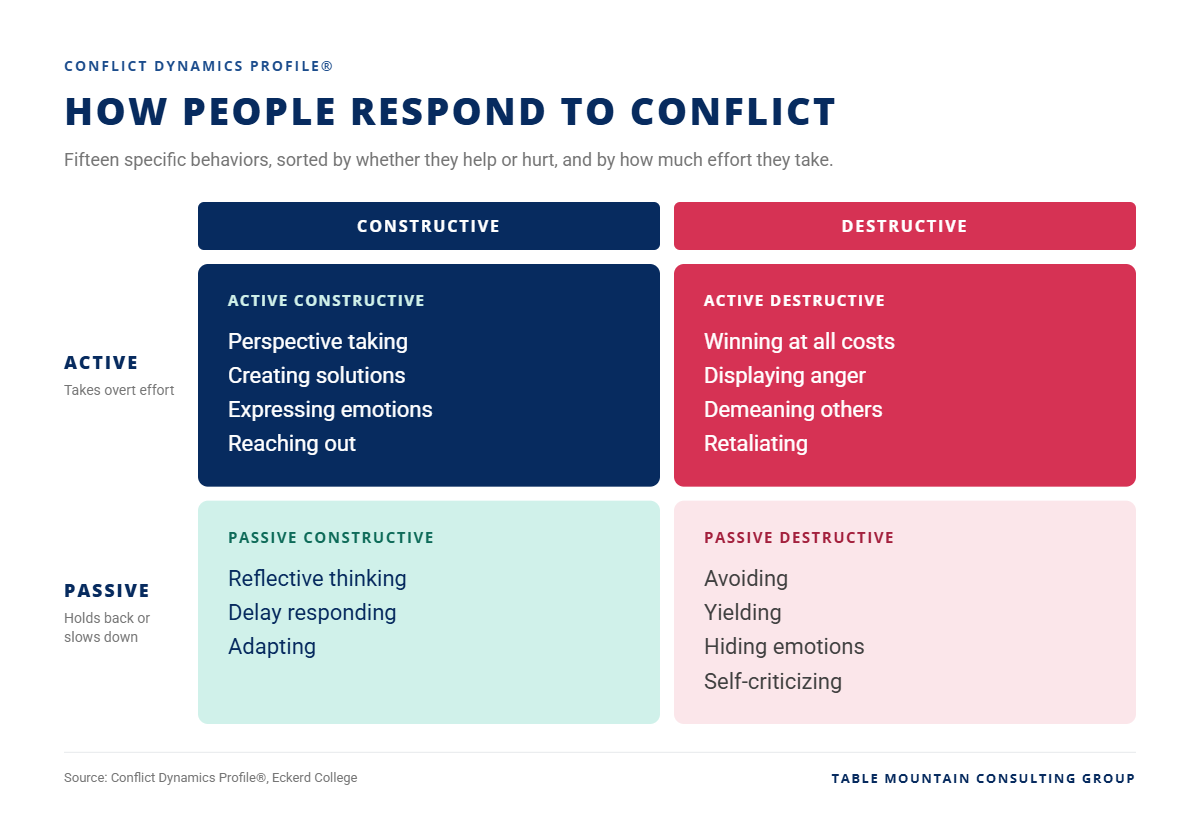
Eckerd’s own conflict research connects these behaviors to how leaders are seen. Active constructive behaviors were associated with higher ratings of leadership effectiveness and suitability for promotion. Active destructive behaviors like winning at all costs and demeaning others had the opposite effect. Bosses found avoidance especially problematic (Runde, Mediate.com).
Avoidance deserves a closer look, because it rarely feels destructive to the person doing it. In moments like these, stepping back can feel like the mature choice. From the inside, it reads as keeping the peace. From the outside, it often reads as absence, apathy, or disengagement. The disagreement does not go away. It moves into side conversations, slower decisions, and quiet workarounds.
Defensiveness and retaliation work differently but end in the same place. They turn a disagreement about the work into a disagreement about the people, which is exactly the shift the team research warns about.
Self-awareness is where the work starts
Most leaders have some sense of how they handle conflict. The question is how complete and accurate that picture is. The CPP study found a telling gap. Nearly a third of managers, 31 percent, felt they were skilled at handling conflict. Only 22 percent of employees said their managers handled it well (CPP, Inc., 2008).
Self-awareness sits on a continuum. Most leaders see part of their pattern clearly. The parts they tend to miss show up under pressure, when the response happens faster than reflection. Those are often the parts everyone else notices first.
Triggers play a large role here. The CDP calls them hot buttons, the behaviors in other people most likely to provoke a reaction. It measures nine of them, including working with someone who is unreliable, overly analytical, aloof, micromanaging, abrasive, or hostile (Eckerd College, CDP Sample Report). Knowing which ones apply to you will not stop them from firing. It gives you a chance to notice the moment and choose a response.
A few questions are worth sitting with.
- When a disagreement starts, what do you do first?
- Which behaviors in others get under your skin fastest?
- How would your direct reports describe you when a conversation gets hard?
- Would your peers describe it the same way?
If you are unsure how others would answer those last two questions, that uncertainty is useful information. It is also why the 360 version of the CDP, which compares your self-view with ratings from bosses, peers, and direct reports, tends to produce the most valuable insights
Conflict competence can be developed
Style describes a tendency. Behavior can change based on choices. That is what makes conflict competence a leadership capability you can build, and the evidence points the same way. In the CPP study, countries where conflict management development was more common reported more positive outcomes from workplace conflict. In the U.S., 81 percent of workers said they had seen something good come out of a conflict, from better understanding of colleagues to better solutions (CPP, Inc., 2008).
The approaches that work tend to share a few features. They start with valid data on what a leader actually does in conflict, drawn from more than one perspective. They connect that data to situations the leader is facing right now. They give the leader a small number of specific behaviors to practice. And they come with someone skilled enough to help the leader make sense of feedback that does not match their self-image.
The work here is not just about one leader getting better at hard conversations. When a team or an organization shares a common language for conflict behavior, people can name what is happening in the moment without making it personal. That shared language is often what lets disagreement stay productive.
It also matters who carries this work inside your organization. Internal coaches, HR business partners, and L&D practitioners already have the relationships and the context. What they usually need is the depth to interpret conflict data well and use it in real development conversations.
Building that capability with TMCG
Table Mountain Consulting Group is now certifying practitioners in the Conflict Dynamics Profile, published by Eckerd College. Certification prepares your internal coaches and talent professionals to administer the CDP, interpret its results, and deliver feedback that leads to real behavior change. Our first live cohorts run in January 2027, with sessions in the U.S. and EMEA.
If conflict is costing your organization more than it should, we would welcome a conversation about where it shows up and what would help. Reach out and we will find a time.